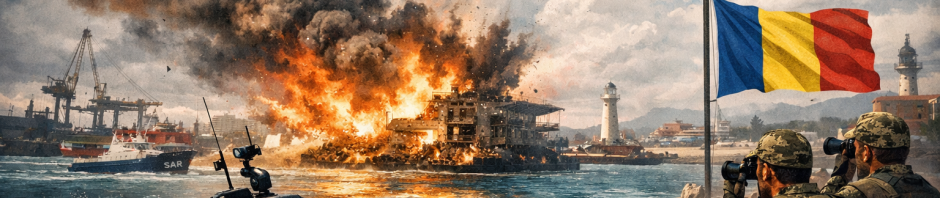
In recent months, the Black Sea has increasingly functioned as a testing ground for contemporary armed conflict, where explosive‑laden naval drones have emerged as both strategic assets and significant sources of transboundary risk. The incident of 5 June 2026- when a Ukrainian naval drone detonated inside the Port of Constanța – illustrates the capacity of unmanned maritime systems to escape operational control and inflict substantial damage on the territory of a neutral or allied state.
This event raises a fundamental question in international law: who bears responsibility when a military drone becomes uncontrollable and causes harm across borders?
1. The Primacy of Flag‑State Responsibility
Under public international law, the state to which a vessel or naval vehicle belongs – including unmanned military systems – is internationally responsible for the damage it causes. The United Nations Convention on the Law of the Sea (UNCLOS) imposes a clear obligation on the flag state to exercise effective control over its vessels and to ensure that their operation does not endanger maritime safety.
UNCLOS Framework
Article 34 establishes that the flag state incurs international responsibility for harm caused to the coastal state through non‑compliance with the latter’s laws or with international legal norms.
This provision applies equally to unmanned maritime vehicles, including naval drones.
Application to the Constanța Incident
Ukraine acknowledged ownership of the drone and attributed the loss of control to Russian electronic interference. Regardless of the underlying cause, the flag state remains responsible for:
- destruction of the Maritime Life‑Saving Agency headquarters;
- damage to the diving equipment storage facility;
- destruction of marine decontamination infrastructure;
- economic losses resulting from the disruption of port operations.
2. Forms of International Responsibility
A. International Civil Liability
The flag state may be required to provide reparation for:
- material damage to infrastructure, vessels, or buildings;
- loss of life or personal injury;
- economic losses, including intervention costs and business interruption;
- environmental harm.
In the Constanța case, Ukraine could be held liable for all such categories of damage.
B. International Criminal Responsibility
If the drone’s use contravened international humanitarian law (IHL)—including the 1949 Geneva Conventions, customary IHL, and general principles of law—the flag state may incur responsibility for:
- unauthorized attacks on another state’s territory;
- violations of the principle of distinction;
- violations of the principle of proportionality.
Serious violations constitute war crimes under international law.
C. Responsibility for Aggression
In exceptional circumstances, the unauthorized entry of a military drone into another state’s territory may amount to an act of aggression or a grave breach of sovereignty, with significant political and legal consequences.
3. Obligations of the Flag State
Pre‑Incident Obligations
The flag state must ensure:
- robust and redundant command‑and‑control systems;
- self‑destruct or fail‑safe mechanisms in case of signal loss;
- prior notification of hazardous operations to maritime authorities;
- compliance with regulations governing explosive materials.
Post‑Incident Obligations
Once control is lost, the flag state is required to:
- promptly notify the potentially affected state;
- cooperate in locating and neutralizing the drone;
- permit intervention by local authorities;
- provide compensation for resulting damage.
4. Limitations of Insurance Coverage in Wartime Contexts
Standard insurance policies typically exclude:
- war and hostilities;
- acts of an external enemy;
- terrorism and sabotage.
Consequently, victims cannot rely on insurance mechanisms and must seek compensation directly from the flag state.
5. The Romanian Legal Framework
Romania has adopted several key instruments to address the risks posed by military drones:
- the National Airspace Control Act (Law 73/2025), authorizing the downing of illegally entering drones;
- the Peace‑Time Military Missions Act (Law 72/2025), enabling cooperation with allied forces;
- the 25 September 2025 CSAT decision mandating the neutralization of uncontrollable military drones;
- the opening of a criminal investigation in rem by the Prosecutor’s Office attached to the Constanța Court of Appeal for violations of weapons and munitions regulations.
6. The Broader Significance of Flag‑State Responsibility
Flag‑state responsibility is not a merely theoretical construct; it serves as a foundational mechanism for:
- ensuring redress for victims who lack access to insurance remedies;
- incentivizing states to maintain strict control over military technologies;
- preventing diplomatic escalation and preserving international stability;
- safeguarding regional security, particularly in the Black Sea area.
In conclusion, when a military drone escapes control and impacts the territory of a neutral or allied state, the flag state bears responsibility irrespective of intent. This principle is central to the law of the sea and to public international law, ensuring navigational safety and contributing to regional stability in an era of rapidly evolving military technologies.

